TR to PR Pathway Canada (2026 Guide): Eligibility, Documents, and Application Process
There is a lot of buzz right now about the new TR to PR pathway in Canada. Many temporary residents are hoping that this new pathway will help them become permanent residents. And, indeed, the program will help many achieve their Canadian immigration goals.
However, it is important to start with a reality check.
The federal government has announced a new TR to PR program that may allow about 16,500 people each year in 2026 and 2027 to obtain permanent residence. While this new pathway is a good opportunity, Canada currently has millions of temporary residents in the country, including international students, foreign workers, and foreign workers who are hoping to stay permanently. This means that the new TR to PR pathway will help some in-Canada applicants, but it will not help everyone.
Many Canada applicants should also remember what happened during the last TR to PR pathway. It was a first-come, first-served race to submit the PR application through the IRCC portal. Some streams were full within a few hours, and many applicants experienced portal crashes and technical problems. The TR to PR pathway is expected to receive a high volume of applications, so early preparation is critical for applicants who want to maximize their chances of success.
We hope the new intake system will be better this time. However, applicants should still prepare carefully and understand all eligibility criteria before the program opens.
This guide explains how the new temporary resident to permanent resident process may work in 2026 and what documents you may need to prepare.
Introduction to Permanent Resident Pathway
The Permanent Resident Pathway is a cornerstone of Canada’s immigration system, offering a structured route for certain temporary residents to become permanent residents. This pr pathway is especially significant for foreign workers who have built established community ties and are actively contributing to the Canadian economy. Through the TR to PR pathway, the federal government aims to grant permanent residence to individuals who have already demonstrated their value to Canadian communities by working in the community.
To qualify for this permanent resident pathway, applicants must hold valid status in Canada, meet minimum language requirements, and provide proof of their employment through essential employment documents. These requirements ensure that only those temporary residents who are well-integrated and meet Canada’s standards can transition to permanent residence. Because the TR to PR pathway is a limited-time opportunity, it is crucial for applicants to prepare their documents in advance and ensure all eligibility criteria are met. By doing so, foreign workers and other eligible temporary residents can maximize their chances of successfully obtaining permanent residence in Canada.
What Is the temporary resident to permanent resident pathway (new TR to PR Pathway) in Canada?
Canada's new TR to PR program is a PR pathway designed for residents on temporary status already living and working in Canada.
Through this PR pathway, eligible in-Canada applicants may transition from temporary status to permanent residence if they meet the program requirements. In other words, the program allows the government to grant permanent residence to people who have already studied or worked in Canada.
The goal is to keep skilled workers and graduates who are already contributing to Canadian communities.
Who Qualifies as a Temporary Resident in Canada?
Temporary residents in Canada include several groups of people.
Some of the most common examples include:
- International students studying with a study permit
- International graduates from a post-secondary institution in Canada
- French speaking international graduates who have completed eligible programs in Canada (they may have a unique application stream or eligibility criteria)
- Temporary foreign workers working with a valid work permit
- Other foreign workers holding temporary permits
This also includes US citizens currently working in Canada under CUSMA/USMCA professional work permits, who are often in a strong position to transition to permanent residency.
Many of these individuals already have strong ties to Canada, such as current employment, family relationships, and community involvement.
Why Canada Created the TR to PR Pathway
Canada’s immigration system often looks for ways to keep people who are already integrated into the country.
Temporary workers and international graduates often:
- have Canadian work experience
- understand Canadian workplaces
- have established community ties
- contribute to Canadian communities
Because of this, the federal government sometimes creates special programs that allow residents on temporary status to apply for PR status.
These programs help address labour shortages in priority sectors and keep skilled workers in Canada.
Canada Immigration Pathways 2026 (Where TR to PR Fits)
The TR to PR pathway is only one option within Canada’s immigration system. There are several Canadian immigration programs that allow people to become PR.
Major Canada Immigration Programs
Some of the most common immigration pathways include:
- Express Entry
- Provincial Nominee Programs (PNP)
- family sponsorship programs
- regional economic programs
Express Entry is a points-based system that selects skilled workers based on factors like education, work experience, and language proficiency.
PNP programs allow provinces to nominate candidates who meet local labour needs.
Canada's new TR to PR program is designed specifically for temporary residents already inside Canada.
Immigration Pathway Comparison Table
| Immigration Pathway | Best For | Canadian Work Experience Required |
|---|---|---|
| TR to PR Pathway | Temporary residents already in Canada | Yes |
| Express Entry | Skilled workers globa | Not always |
| Provincial Nominee Programs | Regional labour needs | Often |
| Family Sponsorship | Family reunification | No |
Each PR pathway has its own eligibility criteria and application process.
TR to PR Pathway 2026 – Latest Updates and Policy Changes
Canada’s new TR to PR program is expected to launch in April 2026. This new pathway will focus on workers who are already living and working in Canada.
Canada PR News Today: Key Changes for Applicants
While final details may still change, early announcements suggest that the new TR to PR pathway may focus on work permit holders such as:
- temporary workers in priority sectors
- foreign workers in a certain occupation
- French speakers and French speaking graduates from Canadian schools
- individuals already working in Canada
The government will also limit the number of applicants each year - 16,500 applications each in 2026 and 2027.
New Immigration Pathway Canada 2026
This new initiative is part of a larger effort to improve Canada's immigration system and retain talent already living in the country.
The goal is to provide a temporary to permanent resident pathway for people who are already contributing to the economy.
TR to PR Eligibility Requirements (2026)
Each PR pathway has specific eligibility requirements. While the final rules for the new tr program may vary, most applicants should expect requirements related to work experience, language ability, and legal immigration status.
Work Experience Requirements
Applicants are likely to need Canadian work experience in an eligible occupation.
This may include:
- employment in an essential occupation
- experience in priority sectors
- current employment with a Canadian employer
Applicants will likely need to provide proof of their work experience through employer reference letters and other documents, such as recent pay stubs, T4 slips, Record of Employment (ROE), CRA notice of assessments, etc.
Employer reference letters usually include:
- job title
- job duties
- employment dates
- salary information
- employer contact information
These letters help immigration officers verify employment history.
Language Requirements
Most PR programs require proof of language proficiency.
Applicants must usually take approved language tests such as:
- Approved English tests:
- IELTS General Training
- CELPIP General
- PTE Core (recently added)
- Approved French tests:
- TEF Canada
- TCF Canada
Language test results must meet the program’s minimum language requirements.
Education and Credential Requirements
Some applicants may need an educational credential assessment (ECA) to confirm that their foreign education is equal to Canadian standards.
International graduates from a Canadian post-secondary institution may not require this step.
Immigration Status Requirements
Applicants must usually hold valid immigration status in Canada.
This may include:
- a valid work permit
- a study permit
- maintained status while waiting for a decision
Maintaining legal status is very important during the PR application process.
TR to PR Supporting Document Checklist (Complete 2026 List)
Preparing the correct documents proof and complete personal information is one of the most important parts of the application.
Missing certain documents can delay your ability to apply to the program, or you may even miss the chance to apply.
Core Identity and Civil Status Documents
Applicants should prepare the following documents:
- valid passport
- travel document
- civil status documents
- marriage certificate (if applicable)
- documents related to family relationships, such as common law relationship or birth certificates for dependent children
These documents confirm identity and civil status.
Employment Documents
Applicants should gather the following documents proving their employment such as:
- employer reference letters including job duties and other essential information
- recent pay stubs
- employment history records
- proof of current employment
- copy of work permit
These documents help demonstrate Canadian work experience.
Immigration and Background Documents
Many immigration programs require:
- police certificates from countries where the applicant lived
- medical examination reports
- detailed travel history
These supporting documents help immigration officers assess admissibility.
Education and Language Documents
Applicants may also need:
- educational credential assessment reports
- language test results
- proof of graduation from a Canadian institution
All documents that are not in English or French will need to be translated by a certified translator.
Personal Information needed for TR to PR application
The TR to PR application process is likely to be a race, where the first 16,500 applications submitted through the IRCC PR portal are accepted for processing. Those who are still in the process of completing their application when the threshold is reached will find that they are unable to submit their application. Those who have not started the application when the threshold is reached, will not even be able to access the IRCC portal. With this in mind, single applicants will have an advantage over those with a family, as single applicants will have less information and less documentation to submit. It's imperative to be well prepared to complete and submit the application as quickly as possible. We recommend preparing spreadsheets of the following information in advance (for yourself and your spouse or common law partner):
- Address history for the past ten years - ensure you have no gaps in the timeline
- Personal history for the past ten years - ensure you have no gaps in the timeline, include the location and whatever you were doing for that specific period of time (working, retired, studying, etc)
- Organizations that you have been a member of and the dates you were associated
- Details of any military service you have performed
- Details of anytime you have worked for the government
- Travel history for the past ten years - the city and country where you travelled, as well as the dates, number of days, and purpose of your travel
- Education history for high school and any post-secondary education including dates of study, name and location of institution, and program completed
- Family information including name, date of birth, country of birth, marital status, address and email address for your parents, siblings and any children
TR to PR Processing Time in 2026
Processing times can vary depending on several factors.
These include:
- completeness of the PR application
- background checks
- document verification
- number of applications submitted
Incomplete applications or missing documents may cause delays, or your application may be returned to you as incomplete and then you have missed the chance to apply.
Police Certificate and ECA Processing Times
Some supporting documents take time to obtain.
Note that these may be needed for family members including spouses, common law partners, and sometimes other dependents.
For example:
- police certificates may take weeks or months depending on the country
- Education Credential Assessment reports often take several weeks
Applicants should prepare documents early to avoid delays.
Step-by-Step Guide to Apply for TR to PR Canada
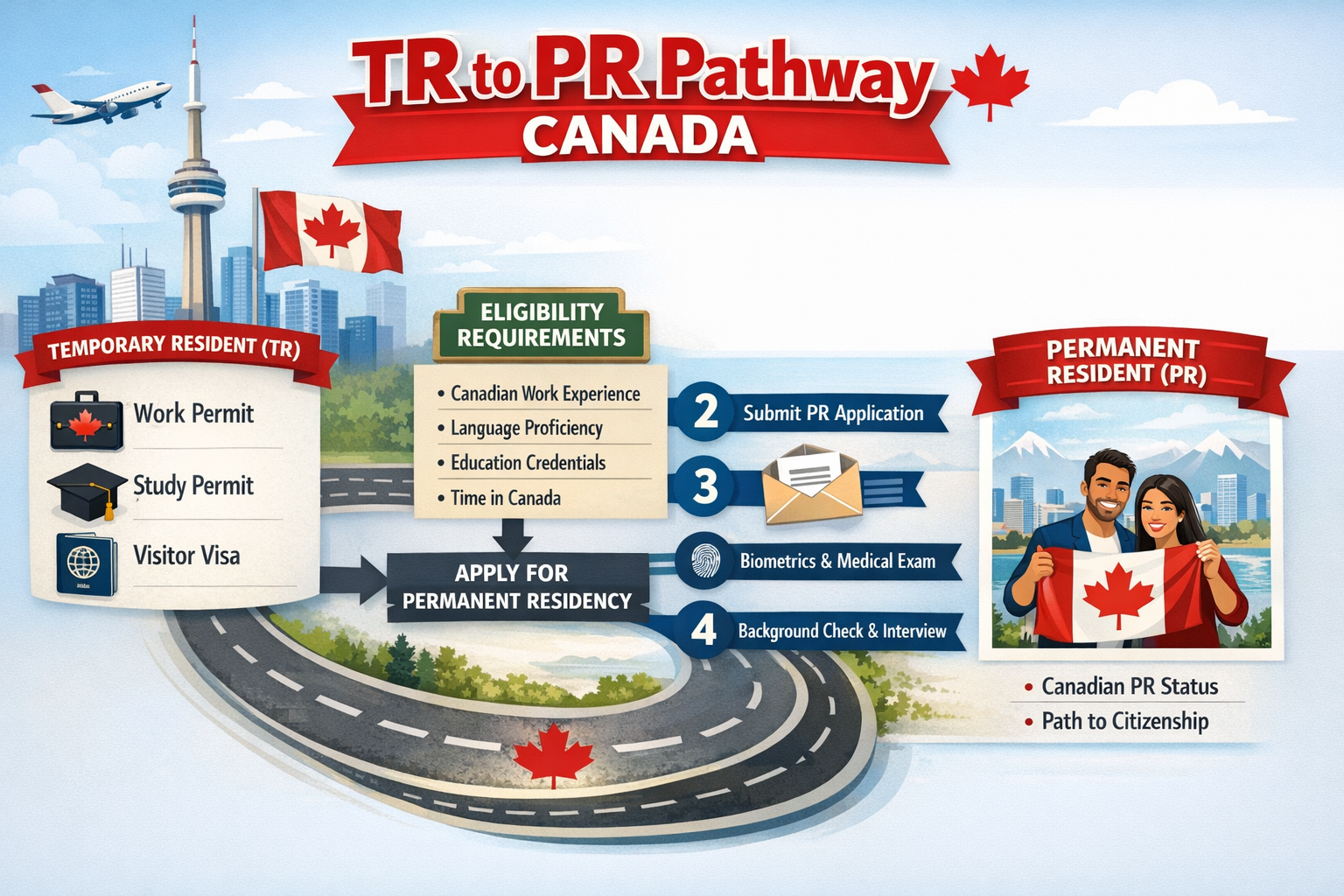
Applying for permanent residence through a TR to PR pathway usually involves several steps.
Step 1: Confirm Eligibility
Before applying, applicants should review the program rules carefully to confirm they meet all eligibility requirements. These rules are expected to be announced in April 2026.
Step 2: Prepare Required Documents
Applicants must prepare documents and gather the required documents before submitting the application.
This may include identity documents, employment documents, language tests, and other supporting documents for everyone included in the application.
Step 3: Submit the Application
Applicants must complete the online application forms and submit the permanent residence application through the IRCC PR portal.
Step 4: Biometrics and Medical Exams
Applicants may need to complete biometrics, medical exams, and background checks after submitting their application.
Step 5: Receive Permanent Residence
If the application is approved, the applicant will receive confirmation of permanent residence.
At that point, they officially become permanent residents of Canada.
Work Permit to Permanent Residency Canada (TR to PR Guide)
Many temporary workers hope to transition from a work permit to permanent residence.
How to Convert Temporary Resident Legal Status to PR Canada
Foreign workers in Canada can apply for permanent residence through different pr pathway options.
Some people may qualify through:
- the TR to PR program
- Express Entry
- Provincial nomination programs
- Spouse or common law partner sponsorship, for those who have Canadian partners
Applicants should ensure they maintain valid temporary status in Canada while waiting for a decision on the PR. This usually means submitting a new application for an extended work permit, or visitor status.
TR to PR vs Express Entry Canada
Both Express Entry and TR to PR programs can lead to permanent residence.
However, they work differently.
Key Differences and Which Pathway Is Better
Express Entry is a points-based system that ranks candidates using the Comprehensive Ranking System. Applicants need to receive an invitation to apply for Express Entry from IRCC.
The TR to PR pathway focuses more on existing Canadian experience, such as work history in Canada. Applicants will need to secure a spot in the portal when the program opens in order to apply.
For some residents on temporary status, the TR to PR pathway may be easier because it does not rely heavily on CRS scores. However, past technical challenges with the IRCC PR portal remind us that when millions of people descend on the same website at the same time, chaos can sometimes ensue.
Express Entry remains one of the most common pathways to PR status in Canada, as it is the economic program that secures PR for the largest number of candidates each year.
Common Challenges When Converting Temporary Residence to Permanent Residence
Many applicants face challenges when applying for permanent residence.
Common issues include:
- expired language test results
- missing documents
- incorrect employment letters
- incomplete document checklist
- problems proving employment history
- not having documents translated by a certified translator
- missing documents for spouse, common law partner or dependent children
Applicants must ensure they provide proof of all required documents in the exact format specified by IRCC.
Why Applicants Choose The Way Immigration for TR to PR Applications
Applying for permanent residence can be complex, especially when programs change frequently.
Expert Guidance on the TR to PR Pathway Canada
Professional guidance from immigration experts can help applicants understand eligibility requirements and choose the best immigration pathway.
Complete Canada PR Document Preparation
Many applicants seek help preparing the document checklist and organizing supporting documents.
This includes help with:
- employment letters
- ECA requests
- immigration forms
- police certificates
Trusted Immigration Consultant for TR to PR Canada
Working with immigration professionals can help reduce mistakes and ensure the permanent residence application is complete. Professional support can make the process smoother and reduce the risk of delays.
Frequently Asked Questions About the TR to PR Pathway
What IELTS score is required for the TR to PR pathway?
Most programs require language test results that meet minimum language requirements, usually between CLB 4 and CLB 7 depending on the program.
How long does an ECA take for Canadian PR applications?
An educational credential assessment usually takes about 4 to 12 weeks, depending on the organization and the documents submitted.
Can temporary workers and international students apply for PR in Canada?
Yes. Eligible international students and temporary foreign workers can apply for permanent residence through several Canada immigration programs, including Express Entry, provincial nomination programs, and potential TR to PR pathways.
Can applicants outside Canada apply?
Generally, no. The TR to PR pathway is designed to prioritize in-Canada applicants, in other words, for residents with temporary status already in Canada with valid status, such as a work permit or other temporary permits. Applicants outside Canada usually need to apply through other Canadian immigration programs, such as Express Entry or Provincial Nominee Programs.
Can family members be included in the TR to PR applications?
Yes. Applicants can usually include family members, such as a spouse or common law partner and dependent children, in the PR application. They must provide supporting documents, such as documents proving the common law relationship, marriage certificate, police certificates, and a valid passport.
Do I need an employer reference letter for IRCC?
Yes. Employer reference letters are important employment documents used to confirm job duties, employment dates, and salary.
Should I consult an immigration expert for TR to PR applications?
Consulting immigration experts is optional, but professional guidance can help ensure applications are complete and meet eligibility criteria.
Conclusion
The TR to PR pathway represents a unique and valuable opportunity for temporary residents, foreign workers, and international graduates to secure permanent residence in Canada. With the federal government’s focus on retaining skilled individuals who have already established themselves in Canadian communities, this PR pathway is an important part of Canada’s immigration system.
Success in the TR to PR process depends on careful preparation—meeting eligibility requirements, gathering all required documents, and providing clear proof of employment, language proficiency, and legal status. It will also involve luck, as only those who can access the IRCC Portal and submit their applications before the program is full will be given consideration.
Given the competitive nature and limited intake of the program, applicants should start preparing early and consider seeking professional guidance to ensure their permanent residence application is complete and accurate.
By understanding the process and preparing thoroughly, temporary residents can take full advantage of the new TR to PR pathway and take the next step toward becoming permanent residents of Canada.
At The Way Immigration, we have decades of experience helping clients with their Canadian PR applications. If you have any questions or need help with your PR journey, contact the Best Immigration Consultants Calgary for a consultation today.
Frances Wipf, RCIC, is recognized globally as an expert in Canadian immigration matters. She is licensed by the CICC to provide legal representation and strategic immigration insights. In practice since 2008, Fran has successfully guided thousands of clients to achieve their Canadian immigration dreams through a combination of realistic assessment, technical excellence, and honest advice.